
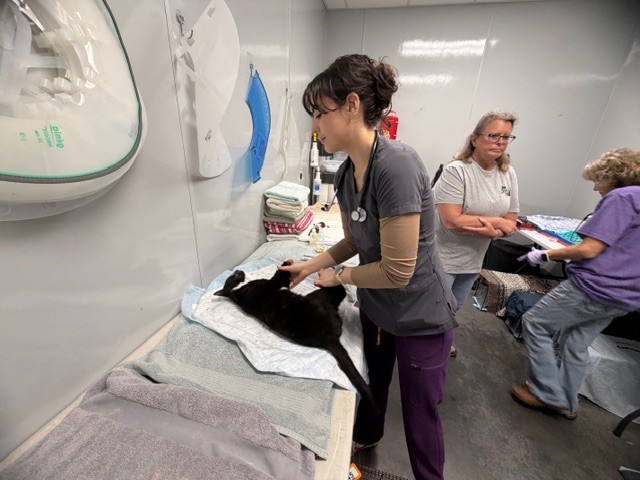
BERKELEY COUNTY, S.C. – More than 120 feral cats from the streets and woods throughout Berkeley County were trapped, caged, and brought to the Charleston Animal Society’s Berkeley Campus over the weekend. They were taken in as part of the “Trap, Vaccinate, Alter, and Return” (TVAR) event at the shelter, meant to help with animal population control county-wide.

“These are the community cats that end up getting pregnant having kittens, then those kittens flood the shelters,” said Shelter Operations Director Christina Ellwood. “These events are great, especially in early spring, because we try to get these animals spayed and neutered before they start having kittens.”
Christina Ellwood says this TVAR event was staffed by two veterinarians and four technicians from the Massachusetts SPCA, who performed the surgeries, as well as volunteers handling cat information intake and pre- or postoperative care.

“Cats were originally wild animals, so a lot of them that are coming through this program are considered feral or wild. Usually, they make their home by some sort of food source. Some colonies are managed by people who go out and feed them, or they end up around a dumpster, and that’s how they get their food,” said Ellwood.
Eventually, volunteers or the caretakers of feral cats will release them back into the wild. In addition to being spayed or neutered, the cats are now microchipped and have a year’s worth of rabies vaccine in their body.

“Studies show that if you remove the cat colony, more cats will just move back in. But if you return cats to their colony, they won’t allow new cats in, and eventually the colony dies off,” said Ellwood.
Zoe Menendez is a volunteer coordinator with Berkeley County Community Cats, one of the groups helping with this weekend’s TVAR event. Helping control the wild cat population is something she got into after seeing firsthand cats reproducing in her backyard, up to 15 kittens in one litter.

“At first I thought this is so cute, then they kept disappearing. And mama kept getting skinnier and skinnier. I didn’t know how big of a problem it was until I saw it firsthand. Being able to take care of these female cats trying to take care of kittens over and over again, it’s very rewarding. And then all of these male cats constantly fighting because of hormones, we can just get them fixed and stop all of that so they can live whatever peaceful life they can,” said Menendez.

Adine Jones is a volunteer who helps and feeds a cat colony in Goose Creek. She says all her cats are fixed and it’s important for all wild cats.
“Every night we feed them, buy our own food, we build them houses,” said Jones. “There won’t be any new cats joining our colony unless and stray comes in, then we can capture that cat and get it fixed.”
The effort is being funded by Charleston Animal Society, Bissell Pet Foundation, ASPCA and the MSPCA.

There’s another TVAR event planned for March and two in April. Charleston Animal Society relies on volunteers and donors to help control the animal population with TVAR events, and adopt out strays. Visit https://casberkeley.org to help.


