BERKELEY COUNTY — When a patient is severely injured, minutes can mean the difference between life and death. Now, emergency responders in Berkeley County will be able to administer blood transfusions before a patient even reaches the hospital.
Berkeley County Emergency Medical Services has launched a new program allowing paramedics to provide prehospital whole blood transfusions at the scene of traumatic injuries or while transporting patients to the hospital. Officials say the agency is the first EMS service in the Tri-County area to carry whole blood in the field.
📣 STAY IN THE LOOP 📣
📰 Sign Up for Berkeley County, SC Newsletter ⬅️
According to EMS.gov, a severely injured trauma patient can die within five minutes from uncontrolled bleeding, making rapid access to blood a potentially life-saving intervention.
“The desire to give every patient the best chance, for our patients and their families to have tomorrow. When we put this blood on the road it becomes a better chance that they have tomorrow,” Berkeley County EMS Chief Michael Shirey said.

Blood available on scene or en route
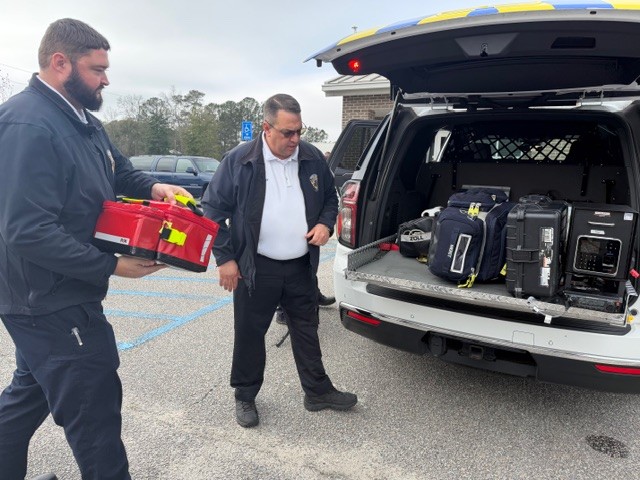
Two EMS supervisor quick-response vehicles will each carry one pint of O-positive whole blood at all times. Whole blood contains red blood cells, plasma and platelets, all essential components needed to treat severe blood loss.
The vehicles will be stationed in Moncks Corner and Summerville, allowing crews to quickly respond to emergencies across the county. EMS supervisors can bring the blood directly to an accident scene or intercept an ambulance already transporting a patient to one of the region’s trauma centers, including Trident Medical Center or MUSC Health University Medical Center.
“We’ve estimated that we will need 50 transfusions a year, that’s 50 patients who will need prehospital blood in a year. Those patients are going to be those who are suffering some type of traumatic injury, motor vehicle accident, shootings, stabbings, long falls, things like that. There are also some other patients who may qualify like postpartum hemorrhage or gastrointestinal bleeding,” Shirey said.

EMS crews trained for new program
All 110 paramedics, emergency technicians and supervisors within Berkeley County EMS recently completed training on how to safely administer the transfusions.
Each pint of blood will be stored in a specialized cooler maintained at 1 to 4 degrees Celsius, with temperatures continuously monitored by supervisors and tracked in real time through a mobile app to ensure safety. The cooler also contains all the equipment needed to begin a transfusion.
“I’m very proud of all the work that’s been done in Berkeley County by our training staff, by our line paramedics, by our supervisors to put together a plan like this, that logistically is a heavy heavy lift. From training and education, and then the coordination with MUSC and be good stewards of the resource,” Shirey said.

Partnership with MUSC
The program was developed in partnership with Medical University of South Carolina, which manages the blood supply through its hospital blood bank.
Blood will be rotated with fresh supplies every 14 to 21 days to prevent expiration and ensure none of the donated blood goes to waste.
“The concept is becoming more accepted and more understandable that this is does prevent death due to hemorrhage in a prehospital setting,” said Emmett Gourdine, Systems Director for Transfusion Medicine at MUSC.
Gourdine said the practice gained widespread attention during military operations overseas.
“This pretty much started in the early 2000s in Iraq and Afghanistan, a lot of those surgeons started using whole blood, were stationed in combat field and brought that concept back here to the United States,” Gourdine said. “With my own experience in the military, I’ve seen it in action in Iraq and Baghdad. I know it saves lives, saved a lot of our combat members who were with injuries and life-threatening hemorrhage. I know it works.”

Cutting precious minutes in emergencies
Chief Shirey said fewer than 2% of EMS agencies nationwide currently carry blood for use in the field, and only six or seven agencies in South Carolina operate similar programs.
Historically in Berkeley County, a patient needing blood had to wait for a medical helicopter to arrive before transfusions could begin — a delay that often averaged 20 minutes or more.
County leaders hope the new program will dramatically reduce that wait.

The equipment and blood storage systems cost $45,000, funded through the EMS operating budget. Officials expect additional funding through a $150,000 grant from the U.S. Department of Transportation’s Safe Streets and Roads program.
Because Berkeley County covers an area roughly the size of Rhode Island, EMS leaders strategically placed the blood-carrying vehicles in Summerville and Moncks Corner, positioning them along routes leading to the region’s closest trauma centers.
The program has been more than a year in the making, with discussions between MUSC and Berkeley County EMS beginning in 2025. Officials say that if demand grows, the county may expand the program to carry additional blood units.
For now, EMS leaders say the goal is simple: get life-saving treatment to patients faster than ever before.